
Sania Fathima
MBA
“The course provided useful knowledge and insights related to the subject. The content was informative and relevant, and it helped me gain a better understanding of the concepts covered.”
SKILLS: Audience Engagement | Content Strategy | Impact Evaluation
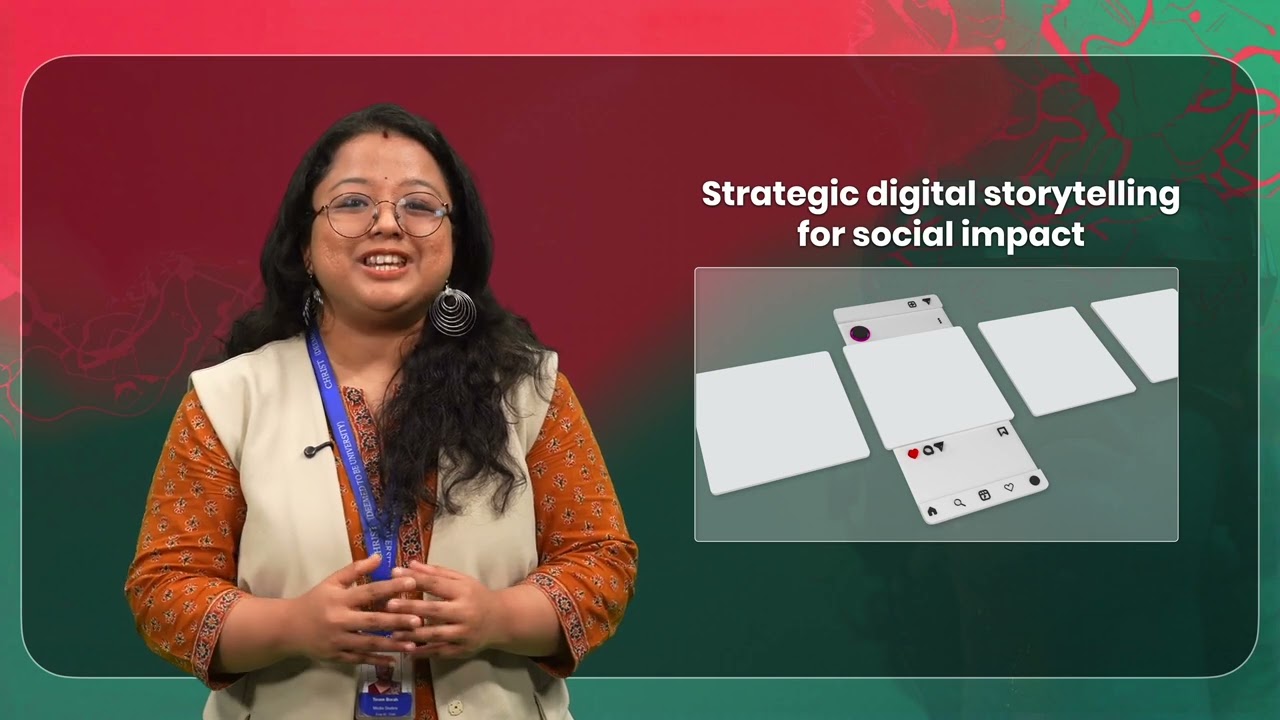
This course aims to develop a critical understanding of digital storytelling as a tool for social impact. It equips learners to examine how stories operate within digital platforms, shape public understanding, and influence social outcomes.
The scope of the course includes narrative design, audience awareness, ethical communication, platform-specific formats, and impact evaluation across contexts such as education, advocacy, community engagement, and professional practice.
In an era of information overload and algorithm-driven visibility, the course is crucial for developing the capacity to communicate responsibly, move beyond superficial engagement, and utilize digital storytelling to promote awareness, accountability, and meaningful social change.
Our curriculum matches modern standard practices to provide exceptional training milestones.
Our curriculum matches modern standard practices to provide exceptional training milestones.
UG and PG Students/Professionals (Educators, Content Creators, NGO workers, Policy Makers)

Expert guidance from acclaimed industry professional leaders.

A meticulous, guided learning path engineered to transform your cloud engineering expertise.
This curriculum covers digital storytelling for social impact. It explores narrative strategies, audience dynamics, and framing ethics across diverse platforms using visual and audio formats. Students examine visibility versus meaning, community engagement across social contexts, and professional applications, learning to evaluate narrative impact using qualitative indicators beyond surface-level metrics.
Hear from CUx learners about their experiences, practical learning, and discoveries beyond the classroom.
MBA
“The course provided useful knowledge and insights related to the subject. The content was informative and relevant, and it helped me gain a better understanding of the concepts covered.”

MBA
“I thoroughly enjoyed the Micro Credential course. It was direct and very informative.”

MBA
“The modules were structured in a simple and accessible way, making the concepts easy to understand even without prior knowledge of the topic. The workbooks provided valuable hands-on practice, and the course was an enriching learning experience that helped me build practical skills and confidence.”

MCA
“The hands-on demonstrations and coding sessions were my favourite part. Overall, it was a valuable learning experience that helped me learn beyond the classroom, explore a new area, and become more curious about what AI can do.”

BCom
“It was interesting to learn about a new topic which was predominant in the world. The videos were short and kept me engaged throughout the course.”