
Sania Fathima
MBA
“The course provided useful knowledge and insights related to the subject. The content was informative and relevant, and it helped me gain a better understanding of the concepts covered.”
SKILLS: Statistical analysis | Data interpretation | AI-assisted decision making
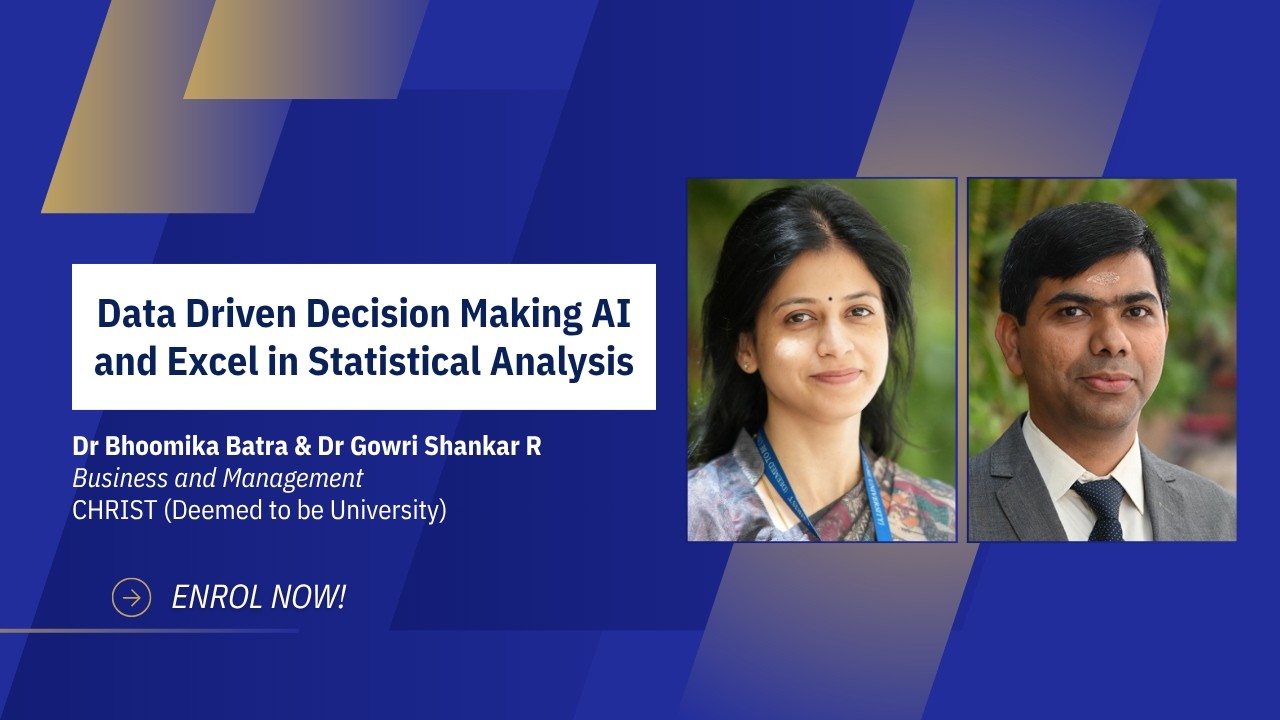
The course "Data Driven Decision Making: AI and Excel in Statistical Analysis" aims to equip learners with the knowledge and practical skills necessary to make informed, evidence-based decisions in today’s data-driven business environment. The primary objective of the course is to help participants understand how data, statistics, and artificial intelligence can be effectively integrated into managerial and financial decision-making processes, moving beyond intuition-based judgments.
The scope of the course covers the complete decision-making cycle—from understanding different types of managerial decisions (strategic, tactical, and operational) to applying statistical techniques using Microsoft Excel and AI-enabled tools. Learners gain hands-on experience with data analysis, descriptive and inferential statistics, scenario analysis, and decision frameworks, as well as the application of AI features in Excel to enhance analytical efficiency. Ethical considerations, data privacy, and the limitations of AI are also addressed to ensure responsible use of technology.
Our curriculum matches modern standard practices to provide exceptional training milestones.
Our curriculum matches modern standard practices to provide exceptional training milestones.
UG students of Commerce, Management, Economics, Finance, Data Analytics, or related disciplines. Postgraduate students and research scholars seeking analytical decision-making skills. Working professionals, managers, and executives across industries. Aspiring data analysts and decision-makers interested in Excel- and AI-based analytics.

Expert guidance from acclaimed industry professional leaders.

A meticulous, guided learning path engineered to transform your cloud engineering expertise.
Concept and significance of Data-Driven Decision Making (DDD).Types of managerial decisions: Strategic, Tactical, and Operational. Overview of business analytics: Descriptive, Predictive, and Prescriptive. Role of Artificial Intelligence in Organizational Decision-Making. Ethics, data privacy, and responsible use of data and AI
Types of data: Categorical and Numerical. Descriptive statistics: Mean, Median, Mode, Variance, and Standard Deviation Probability concepts and basic probability distributions. Correlation and causation in decision analysis. Sampling techniques, bias, and sampling errors. Statistical formulas and functions in Excel (SUM, AVERAGE, STDEV, CORREL, etc.) PivotTables for data summarization and aggregation. Charts, conditional formatting, and data visualization in Excel
Data Analysis Toolpak: Regression, t-tests, and ANOVA. Scenario analysis and data tables in Excel. AI-enabled tools in Excel (Power Query and AI add-ins).Decision-making frameworks: SWOT analysis, Cost–Benefit Analysis, and Decision Trees Limitations and interpretability of AI-based analysis. Communicating insights through dashboards and data storytelling.
Hear from CUx learners about their experiences, practical learning, and discoveries beyond the classroom.
MBA
“The course provided useful knowledge and insights related to the subject. The content was informative and relevant, and it helped me gain a better understanding of the concepts covered.”

MBA
“I thoroughly enjoyed the Micro Credential course. It was direct and very informative.”

MBA
“The modules were structured in a simple and accessible way, making the concepts easy to understand even without prior knowledge of the topic. The workbooks provided valuable hands-on practice, and the course was an enriching learning experience that helped me build practical skills and confidence.”

MCA
“The hands-on demonstrations and coding sessions were my favourite part. Overall, it was a valuable learning experience that helped me learn beyond the classroom, explore a new area, and become more curious about what AI can do.”

BCom
“It was interesting to learn about a new topic which was predominant in the world. The videos were short and kept me engaged throughout the course.”